FORCE PLATE METRICS
IMPULSE-MOMENTUM: SINGLE LEG COUNTERMOVEMENT JUMP (CMJ)
Anyone who has ever used force plates has likely been through the same process… the excitement of them arriving, finding a nice flat surface to put them on, connecting them to the software and seeing the scores upload… then being completely lost in the sheer number of metrics that are available. Having sourced force plates for my own NHS department in 2021, it’s clear that a major barrier to people actually using them is not the execution of the tests themselves, it’s the interpretation of the results. In this blog post, I’ll describe the basics of impulse and momentum during a countermovement jump (CMJ), which provide the foundation for understanding jump metrics. The metrics and images are taken from the VALD ForceDecks system.
The momentum of an object is its mass multiplied by its velocity. An important distinction to be made here is that mass is measured in kilograms, whereas the weight of an object is its mass multiplied by gravity (9.81 N/kg), measured in newtons (N). When you stand on a set of weighing scales, the display gives you your mass, not your weight. If you weighed yourself on the moon, you will weigh less because your mass would be the same as it is on earth, but the moon’s gravity is lower (1.6 N/kg). The greater the mass or the velocity of an object, the greater its momentum. Imagine two cars with the same mass travelling at different velocities on the motorway; the faster car will have greater momentum. Now imagine a car and a bus travelling at the same velocity, the bus will have more momentum due to its greater mass. The unit of measurement for momentum is kilogram metre per second (kg⋅m/s), which is equivalent to newton-seconds (N⋅s).
Impulse is the integral of force over time; the force you apply for the time that you apply it. Force plates record multiple data points per second, depending on the sampling rate selected. If the sampling rate is set to 1000 Hz, 1000 force measurements are collected per second then added together to calculate the impulse. The unit of measurement for impulse is N⋅s, which is the same as momentum, and the two are directly related as impulse is required to increase or decrease an object’s momentum, and the change in momentum is equal to the impulse applied. For example, to increase an object’s momentum from 0 N⋅s to 200 N⋅s you would need to apply 200 N⋅s of impulse. Likewise, to reduce an object’s momentum from 200 N⋅s to 100 N⋅s, you would need to apply -100 N⋅s of impulse. Going back to our vehicle analogy, the faster or heavier vehicle will require a greater impulse to stop as it has more momentum. Now let’s apply this to a single leg countermovement jump.
Downward phase:
At the start of the jump, the person being tested will be stood still and the force plates will be measuring their weight in newtons (FIGURE 1). Since the person is not moving, they will have zero velocity, so, regardless of their mass, they will have zero momentum. As they drop down towards the ground, the impulse created is recorded by the force plates. This impulse will have a negative value, because the force has dropped below body weight. The total force below body weight, for the time it is below body weight, is called the eccentric unloading impulse, and will result in downward momentum.
Using the example given, the eccentric unloading impulse is -46 N⋅s. Since the person had 0 N⋅s of momentum when stood still and -46 N⋅s of impulse was applied, their momentum at the end of the eccentric unloading phase must be -46 N⋅s, as the change in momentum is equal to the impulse applied. Since we now know the momentum and mass of the individual, we can calculate the velocity at the end of the eccentric unloading phase by dividing momentum (-46 N⋅s) by mass (55.6 kg) = -0.83 m/s. Therefore, the greater the eccentric unloading impulse, the greater the downward velocity, as their mass will not change during the jump. However, when comparing jumps on different dates, the mass of the person needs to be considered in case it has changed considerably. Likewise, if adding mass to the person within the same session (e.g., holding dumbbells), the downward velocity will be slower unless the eccentric unloading impulse increases relatively.
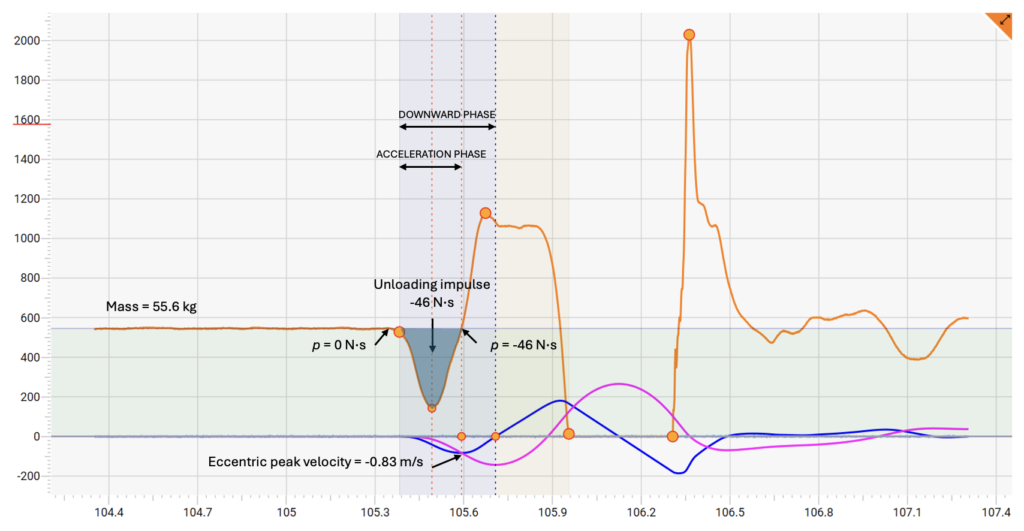
Figure 1: force-time curve showing force falling below body weight and the impulse during the eccentric unloading phase.
Once the force applied to the plates returns to body weight, the person will start decelerating their downward momentum. Given that their momentum at the end of the eccentric unloading phase was -46 N⋅s, an equal but opposite eccentric deceleration impulse of 46 N⋅s is required to return their momentum back to 0 N⋅s and stop at the bottom of the countermovement (FIGURE 2). The eccentric deceleration challenge is therefore dictated by the momentum created during the eccentric unloading phase, which in turn is the product of mass and velocity.
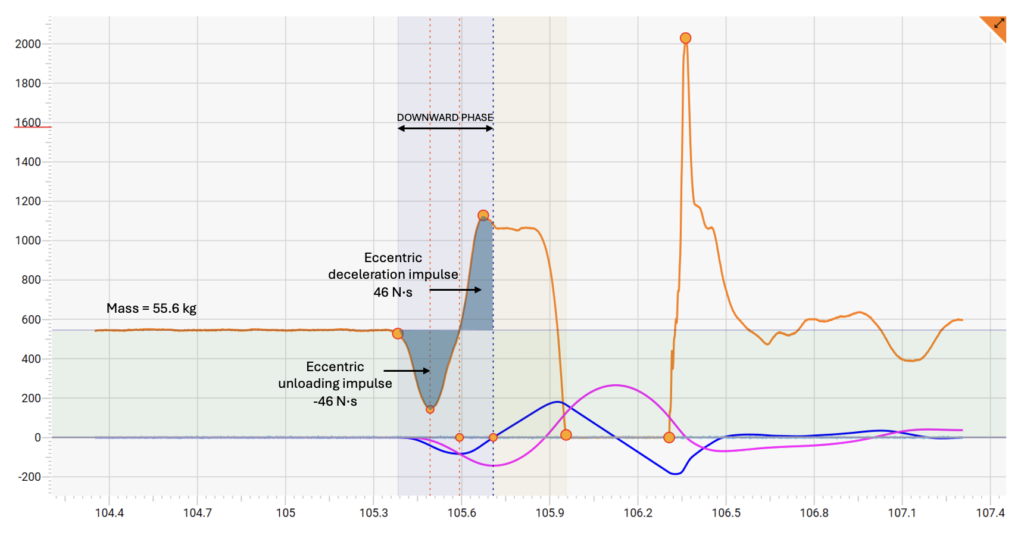
Figure 2: force-time curve showing the eccentric unloading impulse, and eccentric deceleration impulse.
Upward phase:
During the upward phase of the jump, the process described above is reversed as the person now needs to produce a concentric impulse to generate upwards momentum against gravity (FIGURE 3). The concentric impulse is calculated by the force plates, and includes a period where the force is above body weight, plus a brief period where it is below body weight. Since momentum started at 0 N⋅s at the bottom of the countermovement, and impulse equals the change in momentum, the upward momentum at takeoff will equal the concentric impulse, which in turn dictates vertical velocity at takeoff and jump height.
For the person in the example, the concentric impulse is 92.4 N⋅s, therefore upward momentum at takeoff will be 92.4 N⋅s. Vertical velocity at takeoff is the concentric impulse (92.4 N⋅s) divided by mass (55.6 kg) = 1.66 m/s, giving a jump height of 14 cm. Similar to the downward phase, a change in mass will therefore affect jump height if the concentric impulse does not increase relatively.
Together, these examples highlight the relationship between impulse, momentum, mass, and velocity, and form the foundation for understanding force plate jump metrics.
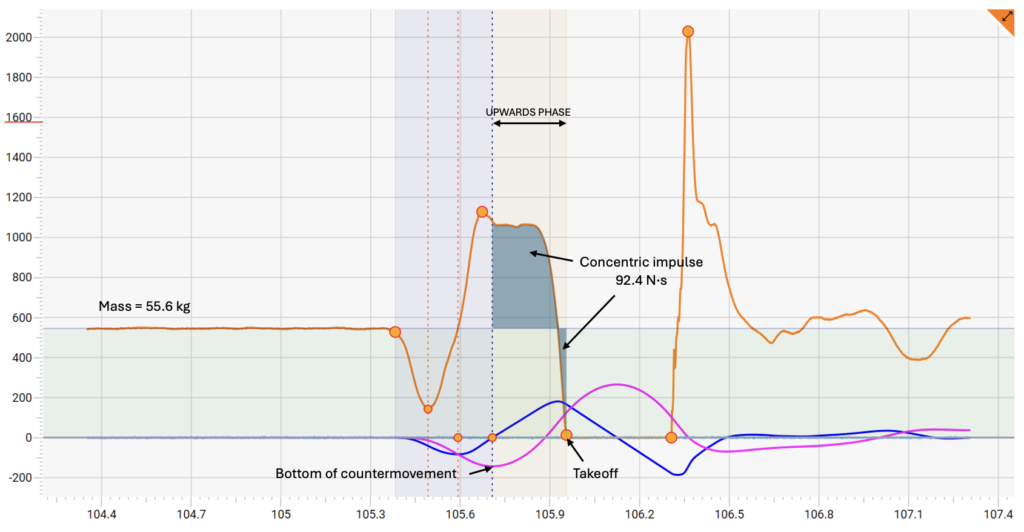
Figure 3: force-time curve showing the concentric impulse.